How to Predict the Application Properties of a Cosmetic Product through Tribology?

In the cosmetic industry, application properties such as spreadability, friction, and after-feel play a decisive role in the consumer’s perception of product quality and pleasantness. However, objectively measuring what is truly “felt” during application remains one of the key challenges in cosmetic research and development. Traditional sensory tests are indispensable, yet they present well-known limitations related to subjectivity, cost, and reproducibility. In this context, tribology stands out as an advanced analytical tool for describing product behavior during skin application.
Tribology studies friction and lubrication phenomena between surfaces in relative motion and makes it possible to simulate, under controlled conditions, the interaction between the skin and the cosmetic film. This is achieved through a configuration known as the ball-on-three-plates setup, in which the product is placed between a glass or steel sphere and three supports made of polymeric materials such as PDMS or PTFE. The outcome of a tribological analysis is the Stribeck curve (Figure 1), which represents the evolution of the coefficient of friction (COF) as a function of sliding speed and allows interpretation of the different phases of the application experience.
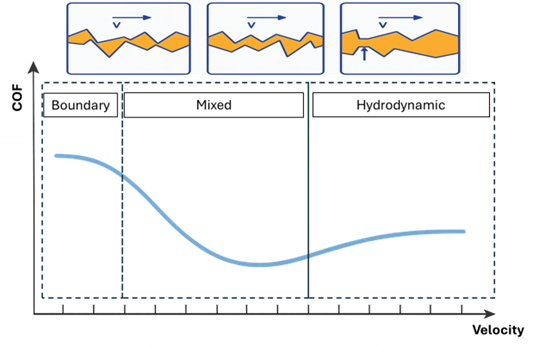
At low sliding speeds, the boundary lubrication regime prevails: the product forms a thin film and friction is high, reflecting the initial sensations upon contact with the skin. As sliding speed increases, the system enters the mixed lubrication regime, characterized by a progressive reduction in friction and directly related to spreadability and glide during application. At higher speeds, in the hydrodynamic regime, the cosmetic film acts as a true lubricant, leading to minimal friction and providing insights into product lightness and the evolution of after-feel.
When integrated with rheology and texture analysis, tribology completes the characterization of the mechanical and application properties of cosmetic products, providing a quantitative basis for product comparison, supporting reformulation strategies, and enabling sensory prediction while reducing empirical trial-and-error approaches.
Thanks to the availability of an advanced rheometer and tribological cell, Unired supports companies in product development and optimization by delivering objective data on application properties and a concrete tool for designing sensory experiences aligned with market expectations.
Contact us at +39 334 6812046 or write to info@unired.it to learn more.
